
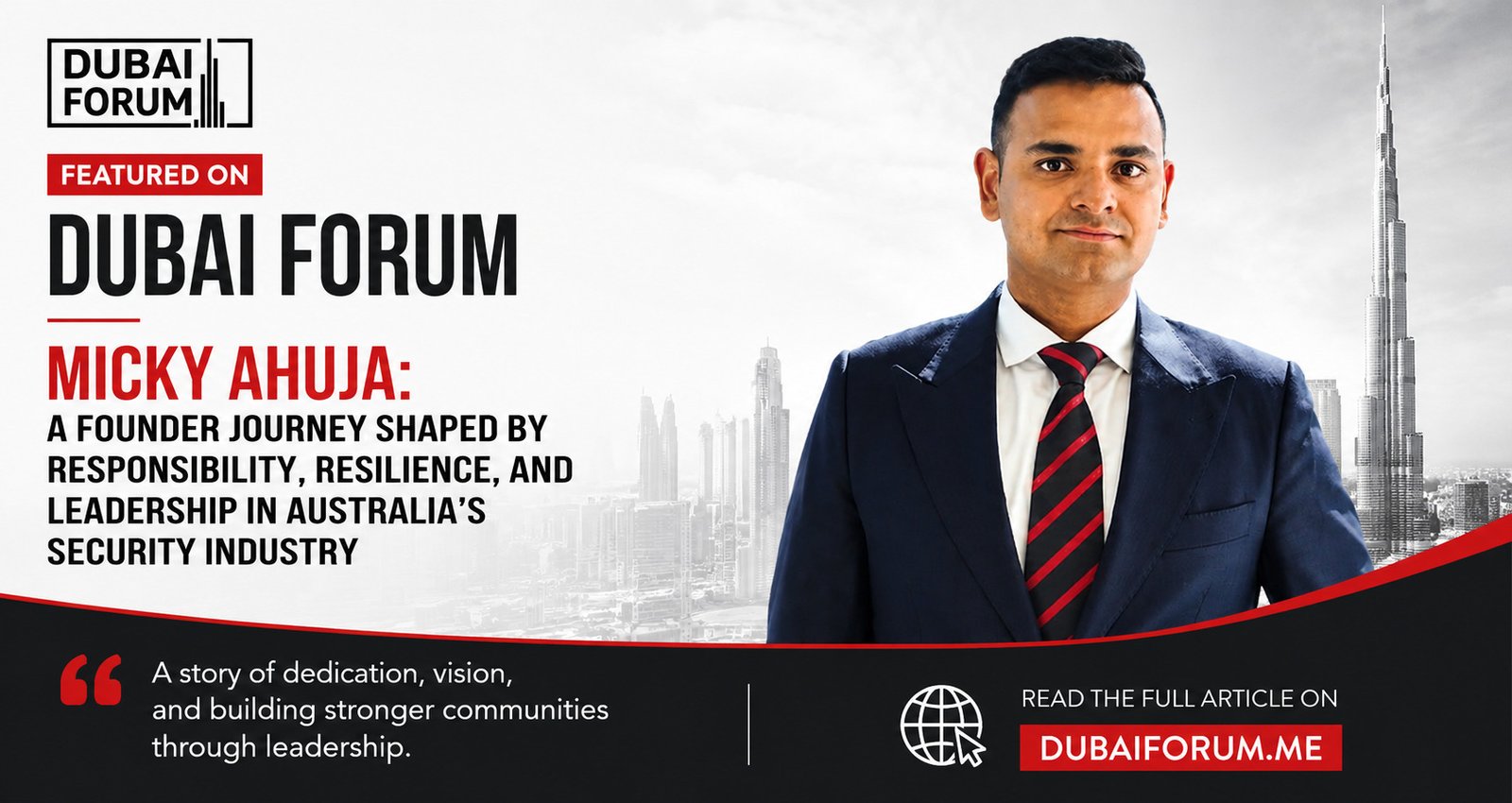
Australian Entrepreneur Micky Ahuja Featured on Dubai Forum
Australia’s security industry is built around people. While technology, monitoring systems, reporting platforms and operational tools continue to evolve, the effectiveness of a security services organisation still depends heavily on the people responsible for delivering services across workplaces, retail environments, commercial properties, events and other locations. For entrepreneurs building businesses in this environment, growth therefore creates a challenge that extends beyond winning contracts. Every new customer, location and employee can add another layer of operational responsibility. Systems need to become stronger, managers need greater capability, compliance needs consistent attention and leaders need visibility across an increasingly complex organisation.
The entrepreneurial journey of Micky Ahuja, who founded the business that developed into MA Services Group, provides an interesting case through which to consider these challenges. His professional experience has included more than a decade operating within security and workforce-intensive professional services environments in Australia.
A recent Dubai Forum profile explored aspects of Ahuja’s founder journey, including the role of responsibility, resilience, governance and continuous learning. Viewed specifically through an Australian security industry lens, however, the story also raises broader questions relevant to founders and executives across the sector: How do you scale a people-intensive security business while maintaining operational consistency? What happens to leadership as employee numbers increase? And why does governance become more important—not less—as an organisation grows?
Security Businesses Face a Different Scaling Challenge
Not every business scales in the same way. A software company, for example, may be able to increase its customer base significantly without increasing its workforce at the same rate. Security services businesses generally face a different economic and operational reality.
Providing services across additional locations frequently requires more personnel, supervisors, rostering, training, communication and management capacity. As the workforce expands, so does the number of everyday interactions and decisions occurring throughout the organisation.
This makes operational discipline particularly important.
A relatively small security provider may initially depend heavily on the founder or a small management team. Senior leaders might personally know most customers, employees and operational requirements. Problems can be escalated directly, and decisions can be made relatively quickly.
That approach becomes increasingly difficult as the organisation expands.
At scale, a business needs systems capable of operating even when the founder is not personally involved. Responsibilities need to be clear. Information needs to reach the appropriate people. Managers need enough authority to resolve routine issues, while significant matters need effective escalation pathways.
In other words, growth gradually transforms security entrepreneurship into an organisational leadership challenge.
Micky Ahuja’s Entry Into the Security Sector
According to published profiles of his business journey, Ahuja entered the security industry in his early twenties after earlier experience in hospitality and while studying Business and Finance at Deakin University in Melbourne.
Those early experiences are relevant because hospitality and security share at least one important characteristic: both can involve delivering services through people in environments where customer expectations are immediate.
Ahuja subsequently founded the business that became MA Services Group, operating within security and related professional services.
Starting within a regulated industry introduces responsibilities that entrepreneurs in some other sectors may not experience immediately. Security businesses need to operate within licensing and regulatory frameworks while simultaneously managing commercial realities such as customer acquisition, workforce availability, service delivery and cash flow.
For a young founder, this creates an environment in which business education can occur rapidly.
Winning a contract is only the beginning. The organisation then needs to deliver what has been promised.
From Founder-Led Operations to Organisational Systems
One of the most important transitions for any growing security company occurs when personal oversight is no longer enough.
During the early stages of entrepreneurship, founder involvement can be an advantage. The founder understands what customers expect, can respond directly to problems and can personally establish standards.
But successful growth eventually makes this approach impossible.
An entrepreneur cannot personally supervise hundreds or thousands of individual interactions occurring across different locations. The organisation therefore needs to convert expectations that once existed in the founder’s head into repeatable systems, documented responsibilities and management structures.
This is where governance begins to have practical operational value.
Governance can sometimes sound like an abstract corporate concept. Within a workforce-intensive security organisation, it has everyday implications. Who has responsibility for a particular decision? How is an incident escalated? What information reaches management? Who checks that required processes have been completed? How are recurring problems identified? How does senior leadership know whether standards are actually being followed?
As an organisation becomes larger, answering these questions consistently becomes increasingly important.
Compliance Is a Continuing Process
Security is also an industry in which compliance cannot simply be addressed once and forgotten.
Licensing requirements, employment obligations, customer requirements, safety considerations and other regulatory responsibilities can create multiple layers of oversight.
An organisation may have appropriate policies, but policies alone do not create compliance. Processes need to be understood, implemented, monitored and reviewed.
This distinction becomes particularly important as employee numbers increase.
Every additional employee creates another set of records, responsibilities, interactions and potential operational variables. Large employers consequently need systems capable of managing information consistently while ensuring that responsibilities are appropriately distributed throughout the organisation.
No compliance framework can guarantee that every individual will behave perfectly in every circumstance. Organisations employing large workforces are dealing with people who have different backgrounds, experiences and behaviours.
The leadership responsibility is to establish appropriate systems, meet applicable obligations, maintain oversight and respond appropriately when issues arise.
Why Workforce Management Becomes a Strategic Issue
In labour-intensive sectors, workforce management should not be treated purely as an administrative function.
Employees are often the organisation from the customer’s perspective.
A security officer arriving at a site, communicating with a customer or responding to an incident represents the company at that moment. Their reliability, professionalism and judgement can directly influence the customer’s perception of the entire organisation.
Recruitment therefore matters, but retention matters as well.
Constant employee turnover can create additional recruitment and training costs while making it harder to maintain continuity across customer sites. Experienced employees may understand environments, expectations and procedures in ways that are difficult to replace immediately.
The same principle applies to managers.
Stable and capable leadership teams can preserve organisational knowledge as a business develops. When experienced managers understand both the organisation and its customers, they can provide continuity while helping newer employees develop.
For founders, this means the people strategy deserves attention alongside the commercial strategy.
Culture Becomes Harder to Maintain as Businesses Grow
Organisational culture can be relatively straightforward when twenty people regularly interact with the founder. It becomes considerably more complicated when employees operate across different sites, shifts and geographic areas.
Leaders cannot personally communicate with everyone every day.
Culture therefore needs to become visible through management behaviour, expectations, systems and everyday decisions.
If an organisation says respect matters, employees will judge that statement through how managers communicate with them. If accountability is described as important, people will observe whether expectations are applied consistently. If leadership says safety or compliance is a priority, employees will notice whether operational decisions support that claim.
This is why scaling culture cannot be achieved through posters or corporate statements alone.
Culture is reinforced by what leaders repeatedly tolerate, recognise, reward and correct.
Leadership at Scale Requires Delegation
Founders frequently build businesses because they are comfortable taking responsibility. Ironically, that same characteristic can become a limitation if they remain unwilling to share responsibility as the company grows.
Delegation is therefore an essential leadership capability.
Effective delegation does not mean simply assigning tasks. Managers need to understand the outcome expected of them, the boundaries within which they can make decisions and when an issue needs to be escalated.
This requires trust.
It also requires founders to accept that another capable person may approach a problem differently.
A mature organisation should not depend on one individual having every answer. It should develop people capable of exercising sound judgement within appropriate systems.
The transition from “I need to solve this” to “we need an organisation capable of solving this” can represent one of the most important stages in a founder’s development.
Operational Resilience Matters in Security Services
Security businesses operate in environments where unexpected situations are part of normal operations. Employees can become unavailable, customers can change requirements, incidents can occur and external conditions can disrupt established plans.
Operational resilience is therefore not simply about recovering from extraordinary events. It is also about having enough organisational capability to manage everyday unpredictability.
Strong processes can help, but resilience also depends on people.
Managers need the confidence to make decisions. Employees need to understand expectations. Communication channels need to function when something changes. Leadership needs enough visibility to identify problems before they become significantly larger.
For growing organisations, resilience is created gradually through experience and continuous improvement.
Learning From Pressure and Change
Long entrepreneurial careers inevitably contain periods that are more difficult than others. Market conditions change, regulations evolve, customers change direction and organisations can experience financial or operational pressure.
These periods can test leadership differently from periods of rapid growth.
Growth often rewards speed and ambition. Difficult circumstances can require patience, accountability and reflection.
A useful leadership question after any challenging period is not simply, “How quickly can we move on?” It is, “What did this experience reveal about our organisation?”
Perhaps a process needs improvement. Perhaps management needs better information. Perhaps responsibilities were unclear. Perhaps an assumption that once made sense no longer reflects current conditions.
Organisations become more resilient when lessons are converted into changes rather than merely remembered.
Continuous Learning in a Changing Security Industry
Australia’s security sector continues to evolve. Technology is changing monitoring, reporting and communication. Customers increasingly expect greater transparency and information. Workforce expectations are changing, while compliance and governance remain important considerations for operators.
Leaders therefore cannot rely entirely on what worked ten years ago.
Experience is valuable because it provides context, but experience needs to be combined with curiosity.
Founders and executives should continue asking how technology could improve operations, what employees need from managers, how customer expectations are changing and where existing processes could become more effective.
Continuous learning is particularly important for leaders because organisational complexity tends to increase faster than any individual’s ability to personally understand every operational detail.
The solution is not for the founder to know everything.
It is to create an organisation that continues learning.
Recognition and the Longer Entrepreneurial Journey
Ahuja has also received recognition through the Australian Young Entrepreneur Awards, an element referenced in published coverage of his professional journey.
Awards can provide external recognition at particular moments, but they represent only a small part of what building an organisation involves.
The less visible work occurs between milestones: recruiting people, maintaining customer relationships, reviewing systems, dealing with problems and making thousands of decisions whose individual importance may only become apparent over time.
For people studying entrepreneurial careers, those periods can sometimes provide more useful lessons than the awards themselves.
What Security Industry Founders Can Take From the Journey
No founder’s experience should be treated as a universal formula. Businesses operate under different circumstances and leadership approaches evolve differently.
However, several broader lessons emerge when examining long-term experience within workforce-intensive security services.
Growth needs systems. Systems need accountability. Large workforces require capable managers. Compliance requires continuous attention. Culture needs to survive beyond the founder. And leadership needs to evolve as organisational complexity increases.
Perhaps most importantly, scale changes the fundamental question facing an entrepreneur.
At the beginning, the question may be:
“How can I build this business?”
Eventually, it becomes:
“How can we build an organisation capable of performing consistently without depending on me for every decision?”
That transition sits at the heart of leadership in workforce-intensive industries.
A Broader Conversation for Australia’s Security Industry
Micky Ahuja’s founder journey provides one perspective through which to examine these issues, but the questions extend across Australia’s security industry.
As security organisations respond to changing technology, workforce expectations, regulatory obligations and customer requirements, leadership capability will remain important.
The industry’s future will not be determined by technology alone. It will also depend on how effectively organisations recruit and develop people, establish accountability, strengthen governance and create operational systems capable of adapting to change.
For current and emerging security entrepreneurs, this creates an important lesson: winning business creates an opportunity, but building the organisation capable of delivering it consistently creates sustainability.
That distinction may ultimately separate businesses that simply grow from organisations that develop the systems and leadership required to operate effectively at scale.