
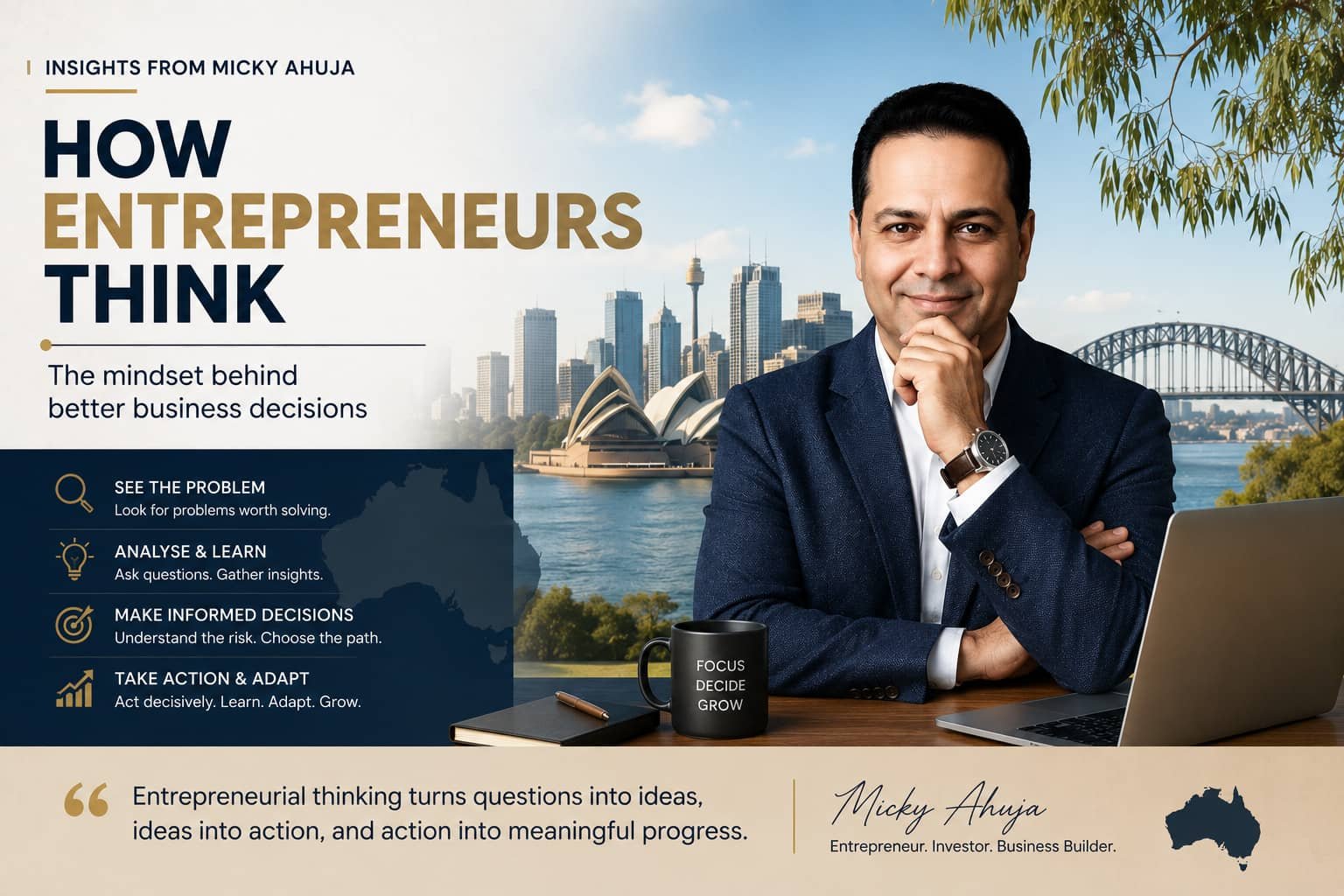
Micky Ahuja Shares His Perspective on How Entrepreneurs Think
Entrepreneurship is often associated with starting companies, taking risks, developing new products and pursuing growth, but behind all of those activities is something more fundamental: a particular way of thinking. Entrepreneurs do not necessarily have access to information that nobody else possesses, nor do they always predict what will happen next. What can distinguish entrepreneurial thinking is the way problems, uncertainty, opportunities and decisions are approached. Where one person may see an obstacle, an entrepreneur may begin asking whether there is a problem worth solving. Where established processes appear inefficient, entrepreneurial thinking asks whether there could be a better approach. Where circumstances change unexpectedly, the focus shifts from wishing things were different to understanding what can be done next. From my perspective, this mindset is not limited to people who have founded companies. Entrepreneurial thinking can be valuable for business leaders, managers, employees and anyone responsible for creating solutions in an environment that continues to change. It involves curiosity, calculated decision-making, adaptability, resilience and, perhaps most importantly, the willingness to turn thinking into action.
Entrepreneurs Look for Problems Worth Solving
One of the foundations of entrepreneurial thinking is learning to recognise problems as potential opportunities. Every day, customers experience frustrations, organisations operate inefficient processes and industries encounter changing expectations. Many successful business ideas begin not with somebody trying to invent something extraordinary, but with somebody noticing that an ordinary problem could be solved more effectively. This requires observation. Entrepreneurs need to pay attention to what customers are saying, what employees are experiencing and where existing solutions appear unnecessarily complicated, expensive or inefficient. The important distinction is that not every problem represents a viable business opportunity. Entrepreneurs need to consider whether enough people experience the problem, whether they care sufficiently about solving it and whether a practical solution can create sustainable value. Asking these questions transforms an observation into a commercial investigation. Instead of simply saying, “This doesn’t work very well,” entrepreneurial thinking asks, “Why doesn’t it work, who does that affect, and is there a better way?”
Curiosity Comes Before Opportunity
Entrepreneurs tend to ask questions because questions expose assumptions. Why has something always been done this way? What has changed in the market? What are customers asking for that businesses are not providing? Which tasks consume unnecessary time? How could technology simplify an existing process? What would happen if a service were delivered differently? These questions do not guarantee a successful idea, but they create the conditions in which new ideas can emerge. Curiosity is particularly important because established ways of working can become invisible over time. When people repeatedly follow the same process, they may stop questioning whether that process still makes sense. Entrepreneurs need enough respect for experience to understand why systems exist, while maintaining enough curiosity to challenge them when circumstances change. This balance matters. Innovation should not mean changing something simply because change appears exciting. It should mean identifying an opportunity to create greater value, improve an outcome or solve a genuine problem.
Entrepreneurs Think in Possibilities, but Decisions Need Evidence
Optimism is often associated with entrepreneurship, and understandably so. Building something new requires believing that a different outcome is possible. However, optimism without evidence can become dangerous. Strong entrepreneurial thinking combines possibility with commercial judgement. An entrepreneur might believe that a new service has significant potential, but that belief should lead to questions about customers, competition, costs, execution and demand. Can the idea be tested on a smaller scale? What evidence would indicate that customers genuinely value it? What assumptions need to be proven before significant resources are committed? This approach allows entrepreneurs to remain ambitious without becoming careless. There is an important difference between saying, “I believe this will work,” and saying, “I believe this could work, so here is how we are going to test it.” The second approach creates an opportunity to learn before making larger commitments.
Calculated Risk Is Different From Recklessness
Entrepreneurship and risk are closely connected, but successful entrepreneurship should not be confused with taking unnecessary risks. Every meaningful business decision involves uncertainty. A new employee may or may not perform as expected. A new market may develop differently from forecasts. A technology investment may produce greater or smaller benefits than anticipated. Entrepreneurs cannot eliminate this uncertainty, but they can become better at evaluating it. Calculated risk involves understanding what could go wrong, estimating the potential consequences and considering whether the possible upside justifies the exposure. It also means asking whether the business can recover if the decision does not produce the expected result. The objective is not to wait until there is zero risk, because that moment rarely arrives. The objective is to understand enough about the situation to make a responsible decision and then remain prepared to respond as new information becomes available.
Action Separates Ideas From Entrepreneurship
Ideas are everywhere. People regularly identify businesses they could start, products that should exist and services that could be improved. The difficult part is execution. Entrepreneurial thinking becomes meaningful when ideas are translated into action. That action does not necessarily need to begin with a major financial commitment. It could involve speaking with potential customers, building a basic prototype, researching competitors, testing a service with a limited audience or developing a small pilot project. These actions create feedback, and feedback creates knowledge. One of the mistakes aspiring entrepreneurs can make is spending too long trying to perfect an idea privately before allowing the market to respond. The real world frequently exposes assumptions that planning cannot identify. Entrepreneurs therefore need the confidence to begin while remaining humble enough to modify what they have begun.
Entrepreneurs Become Comfortable Making Decisions Without Perfect Information
Business leaders rarely receive all the information they would ideally like before making a decision. Waiting for complete certainty can create its own risks because opportunities can disappear and problems can become larger while a decision is delayed. Entrepreneurial thinking requires becoming comfortable with informed uncertainty. This means gathering the most relevant information available, understanding what is unknown and deciding whether enough is known to move forward. Some decisions deserve extensive analysis because they are expensive or difficult to reverse. Others can be made relatively quickly because the consequences are limited and the decision can easily be changed. Understanding the difference can improve both speed and judgement. Entrepreneurs do not need to make every decision instantly; they need to recognise which decisions require careful consideration and which require action.
Adaptability Is More Valuable Than Being Attached to the Original Plan
A business plan provides direction, but reality does not have an obligation to follow it. Customer behaviour may differ from expectations, costs may change, competitors may respond and technology may alter the market. Entrepreneurs who become emotionally attached to their original plans can continue investing in an approach long after evidence suggests that something needs to change. Adaptability is therefore one of the most important characteristics of entrepreneurial thinking. Changing direction should not automatically be viewed as admitting failure. Sometimes it represents better judgement based on better information. The objective should remain relatively stable—create value and build a sustainable organisation—but the method used to achieve that objective may evolve repeatedly. Entrepreneurs need to know the difference between persistence and stubbornness. Persistence means continuing towards a worthwhile objective despite difficulties. Stubbornness means continuing with the same approach even when evidence suggests that approach is not working.
Failure Should Produce Information
No entrepreneurial journey unfolds exactly according to plan. Products underperform, opportunities disappear, hiring decisions sometimes prove unsuccessful and strategies occasionally fail to deliver the expected results. Entrepreneurs need resilience, but resilience should involve more than simply trying again. A setback becomes genuinely useful when it produces information. What assumption proved incorrect? What warning signs were overlooked? Was execution weak, or was the original strategy flawed? Did the organisation understand the customer correctly? Was the timing wrong? Could the downside have been limited? Asking these questions transforms failure from an emotional experience into a source of business intelligence. That does not mean entrepreneurs should celebrate every mistake. Some mistakes are expensive and should have been prevented. The objective is to ensure that when mistakes occur, the organisation learns enough from them to reduce the likelihood of repeating them.
Entrepreneurs Focus on Value, Not Simply Ideas
A clever idea has limited commercial importance unless somebody finds it valuable. Entrepreneurial thinking therefore needs to remain connected to customers. What does the customer actually want? Which problem are they trying to solve? What are they willing to pay for? What would make their experience better? Businesses can become distracted by what they want customers to appreciate instead of paying attention to what customers genuinely value. Staying close to the market can help entrepreneurs avoid this problem. Customer conversations, feedback, complaints, purchasing behaviour and retention can all provide useful signals. Entrepreneurs should be prepared to listen even when the feedback challenges their original assumptions. Ultimately, customers determine whether a business proposition creates enough value to survive.
Time Is an Entrepreneurial Resource
Entrepreneurs frequently think about money as a scarce resource, but time and attention can be equally important. Every new opportunity competes for management attention. Every unnecessary meeting consumes time that could have been spent elsewhere. Every problem that repeatedly requires the founder’s involvement can prevent attention from being directed towards higher-value decisions. Entrepreneurial thinking therefore includes prioritisation. What genuinely needs to happen today? What can be delegated? What can be automated? Which opportunity supports the long-term direction of the organisation, and which is simply distracting because it is new? The ability to say no can become increasingly important as opportunities increase. Successful entrepreneurs are not necessarily the people doing the greatest number of things. They are often the people who become better at identifying which things deserve their attention.
Building the Right Team Changes How an Entrepreneur Thinks
In the beginning, founders may personally handle sales, operations, customer relationships and administration. As a business grows, this approach becomes unsustainable. Entrepreneurial thinking therefore needs to evolve from “How can I do this?” towards “How can we build an organisation capable of doing this consistently?” That requires people. Hiring capable employees, establishing responsibilities, communicating expectations and creating accountability become essential parts of scaling. Entrepreneurs also need to accept that they will not always be the smartest person in every conversation. In fact, one of the objectives of building a strong organisation should be to surround yourself with people who know considerably more than you do in their areas of expertise. Leadership is not weakened when somebody else has the better answer. Strong leadership creates an environment where the best answer can emerge regardless of where it comes from.
Listening Is an Entrepreneurial Skill
Entrepreneurs are frequently celebrated for confidence, but listening can be just as valuable. Employees working directly with customers may notice emerging issues before management does. Customers can explain why a product or service is failing to meet expectations. Advisers can identify risks that enthusiasm has overlooked. Even competitors can provide useful information through the decisions they make. Listening does not mean following every piece of advice. Entrepreneurs still need to evaluate information and make their own decisions. The advantage comes from having more perspectives available before making those decisions. Confidence should enable entrepreneurs to hear disagreement rather than protect them from it.
Technology Is Changing How Entrepreneurs Identify Opportunity
Artificial intelligence, automation, cloud technology and digital platforms are creating new possibilities across industries. Entrepreneurs can access capabilities today that would have required considerably larger organisations in previous decades. However, entrepreneurial thinking should begin with the problem rather than the technology. Asking “How can we use AI?” may produce interesting ideas, but asking “Where are we wasting time, and could AI help?” is often commercially more useful. Technology should support an objective. It can automate repetitive processes, improve access to information, support customer service or help employees work more effectively. Entrepreneurs who understand both technology and the underlying business problem will be better positioned to identify opportunities that create lasting value rather than simply following trends.
Entrepreneurs Think Beyond Today’s Business
Managing today’s operations is necessary, but entrepreneurs also need to consider tomorrow. How could the industry change? What will customers expect several years from now? Which skills will employees need? What technology could alter the economics of the sector? Where might new competitors emerge? Strategic thinking involves exploring these questions before the answers become obvious. Entrepreneurs cannot predict the future perfectly, and attempting to do so can create false confidence. What they can do is develop organisations capable of responding when change occurs. This might involve investing in employee development, improving technology, maintaining financial flexibility or experimenting with emerging opportunities on a manageable scale. Preparing for multiple possibilities can sometimes be more valuable than betting everything on one prediction.
Entrepreneurial Thinking in the Australian Business Environment
Australia provides an interesting environment for entrepreneurial thinking because established industries operate alongside rapidly developing technologies and changing customer expectations. Opportunities can emerge across professional services, technology, construction, healthcare, education, logistics, sustainability and many other sectors. Australia’s diverse population and connections with the Asia-Pacific region can also encourage entrepreneurs to consider different markets and customer needs. However, opportunity does not remove the need for execution. Australian entrepreneurs still need to understand customers, build capable teams, manage finances responsibly and adapt as regulations, technology and economic conditions evolve. The businesses that succeed over the long term will likely be those capable of combining ambition with disciplined execution.
How Entrepreneurs Can Develop Their Thinking
Entrepreneurial thinking is not necessarily something people either possess or do not possess. Many aspects can be developed through practice. Start by becoming more observant. When something appears inefficient, ask why. When customers complain, look for patterns. When a business process consumes too much time, investigate alternatives. Read beyond your immediate industry and speak with people whose experiences differ from your own. Challenge assumptions, particularly assumptions that have existed for a long time. Before making an important decision, ask what evidence supports it and what evidence would prove it wrong. After significant decisions, review the outcome. What worked? What did not? What would you do differently? These habits gradually improve judgement because they encourage entrepreneurs to treat everyday business experiences as opportunities to learn.
The Micky Ahuja Perspective: Think, Learn, Adapt and Act
For me, entrepreneurial thinking can be reduced to several fundamental behaviours: observe carefully, ask better questions, understand the risk, make a decision, learn from the outcome and remain prepared to adapt. Entrepreneurship is not about having every answer before beginning. It is about developing the judgement to move forward responsibly when the answers are incomplete. It is also about recognising that your original idea may evolve, that other people may have better solutions and that previous success does not guarantee future results. The strongest entrepreneurial mindset combines confidence with curiosity, ambition with discipline and persistence with adaptability.
Ultimately, entrepreneurs think differently because they train themselves to look beyond what exists today. They see a problem and ask whether it can be solved. They see an inefficient process and ask whether it can be improved. They see uncertainty and ask what information is needed to make a decision. Most importantly, they understand that thinking alone does not create progress. Entrepreneurial thinking turns questions into ideas, ideas into decisions and decisions into action. That process—repeated consistently over time—is where opportunities can become businesses and where entrepreneurs continue developing alongside the organisations they build.